
Custom Satellites: How Bespoke Smallsat Manufacturing Works and When It Makes Sense
Most organizations that commission their first satellite arrive with the same uncomfortable combination of clarity and confusion. The mission? Crystal clear. The path to orbit? Anything but.
It doesn't have to be that way.
Bespoke smallsat manufacturing has changed dramatically over the past decade. What once demanded five years and a budget with too many zeros can now happen in 12-18 months for organizations that have never owned a spacecraft before. The process isn't as opaque as it seems once you understand how it actually works.
This article walks you through all of it:
What a custom satellite really means.
How the development process unfolds from first conversation to on-orbit commissioning.
How to decide between adaptable and off-the-shelf.
And most importantly: how to know when your mission is genuinely ready to move forward. The focus is the 75–500 kg smallsat range, where adaptable manufacturing is most active and most relevant for commercial and institutional buyers today.
What an Adaptable Custom Satellite Actually Is, and What It Isn't
The Working Definition
"Custom satellite" is the phrase most buyers reach for when they want a spacecraft built around their mission rather than pulled from a catalog. It's the right instinct. But what it actually means in practice varies enormously depending on who's building it.
At one end of the spectrum sits pure bespoke design: every component is selected or built from scratch, every system architected from a blank page. It's the most flexible approach but also the slowest and most expensive. At the other end sits a standard catalog platform with minimal adaptation. Fast and affordable, but your mission has to fit what the platform allows. Most buyers end up somewhere in between.
Reflex calls their approach “adaptable.” Rather than starting from scratch every time, their Praetora platform provides a proven foundation that gets configured around your specific payload requirements. Your payload drives the design; the bus configuration, power architecture, structural interfaces, and communications systems all follow from what your instrument needs to do. That's a meaningful distinction from both pure bespoke and pure catalog platforms. It's what makes a 12-18 month delivery credible for demanding missions without sacrificing performance.
Think of it like a high-end tailor working from a proven pattern. They're not cutting cloth from scratch on every order but they're absolutely not handing you something off the rack either. The result fits you precisely, and it arrives faster than a from-scratch design ever could.
Common Misconceptions Worth Addressing
Bespoke means more expensive. Not automatically. Off-the-shelf platforms carry hidden costs that rarely show up in the initial quote: the engineering effort spent forcing your payload into a platform it wasn't designed for, the performance margins you give up along the way, and in the worst cases, a mission that simply doesn't deliver what you needed. Modern adaptable manufacturing has also brought unit economics down considerably.
Bespoke means slower. This was true of old-school space programs. It isn't true anymore. Experienced manufacturers working in the 100–500 kg range routinely deliver from contract signature to flight-ready hardware in months, not years. The key word is experienced.
Only governments and large primes commission bespoke satellites. Commercial remote sensing operators, defense technology companies, communications startups, research institutions, and more are all active buyers today. The market has opened up and manufacturers have adapted their engagement models accordingly.
You need to be a satellite engineer to commission one. You need operational clarity: what your satellite must do, what data or signal it needs to produce, and what orbit makes sense for your application. The engineering is the manufacturer's job. Arrive with a mission concept, not a subsystem specification. At Reflex, this is a collaborative effort to make sure we are addressing all of the inputs we receive from a customer. We guide the process, but ultimately, our goal is to make sure you get what you want out of your satellite.
CubeSats are good enough for most missions. CubeSats have genuine appeal: they're standardized, affordable, and well understood. But their performance has real limits. For missions that need serious pointing accuracy, high-throughput downlinks, active radar payloads, or multi-sensor configurations, CubeSats simply don't have the power budget, volume, or structural capacity to deliver. When performance and reliability matter, the 100–500 kg class is where things get interesting.
Smallsat Platform Classes
A Note on Terminology
Smallsat Classification by weight according to NASA’s State of the Art Small Spacecraft Technology Report 2024
Before going further, a quick word on classification. The satellite industry hasn't agreed on a universal taxonomy and different sources use different terms for the same mass ranges. Reflex calls the 100–500 kg range smallsats. Others might refer to satellites in this range as microsatellites, minisatellites, or small satellites depending on where they sit within it. Throughout this article, we will be refering to "smallsat" as the 100–500 kg range. If you encounter different terminology elsewhere, that's normal. Just make sure to check the mass range rather than the label.
Why Platform Class Matters First
Platform class isn't just a technical specification. It's the envelope your entire mission has to fit inside. Mass, volume, and power are the three main currencies of spacecraft design and each platform class defines how much of each you have to work with.
Get this wrong early and you pay for it throughout the program. A bus that's too small forces performance compromises or requires a redesign mid-development. A bus that's too large adds cost and launch complexity you don't need. And beyond design constraints, platform class can also affect which orbits your satellite can access. Mass and size influence your launch vehicle options and therefore where in space you can actually go.
Smallsats: Lower Range (75–150 kg)
The lower end of the smallsat range offers a compelling entry point for missions that need genuine performance without the cost and complexity of a larger bus. Compared to CubeSats, you get real payload volume, meaningful power budgets, and enough structural real estate for sophisticated instruments.
Single-payload configurations dominate in this class. Typical missions include technology demonstration, lower-resolution earth observation, and communications payloads with modest throughput requirements. Where this range starts to strain is with power-hungry active payloads, particularly radar instruments, which generally need a larger bus to operate properly. For passive optical instruments and moderate-throughput comms, however, this class often hits the sweet spot of capability versus cost.
Smallsats: Upper Range (150–500 kg)
This is where most high-performance custom missions live. The upper smallsat range handles demanding payloads that smaller platforms simply can't support: high-resolution optical instruments, synthetic aperture radar (SAR), wide-band communications systems, and multi-sensor packages requiring significant onboard processing.
Power budgets scale into the kilowatts here, enabling active radar and high-throughput downlinks. Attitude control systems achieve the precise pointing that serious imaging missions demand. And because satellites in this class are typically designed for dual-use from the ground up, capable of serving both commercial and institutional or defense purposes simultaneously, they suit mission profiles that need to deliver across multiple stakeholder requirements at once.
Development typically runs 12–18 months with an experienced manufacturer. Where in that range your program lands depends significantly on payload complexity, supply chain availability, and the timeline it takes to define your firm requirements.
| Class | Mass Range | Typical Dev Timeline | Best Suited For |
|---|---|---|---|
| Smallsat: Lower | 75–150 kg | 12–15 months | Tech demo, single-payload EO, comms |
| Smallsat: Upper | 150–500 kg | 14–21 months | High-res EO, SAR, SATCOM, dual-use, multi-payload |
The Adaptable Satellite Development Process From Brief to Orbit
The development process follows a clear sequence. Understanding each phase, like what goes in, what comes out, and why it matters. It removes most of the uncertainty that first-time buyers bring into these programs.
Phase 1: Mission Requirements Definition
Everything starts here. Before any engineering work begins, the manufacturer needs to understand what your satellite must actually accomplish. Not how it should do it, that's their job, but what mission success looks like once it's in orbit.
Your payload requirements sit at the heart of this phase. They define what the satellite needs to carry, how that payload needs to operate, and what constraints it places on the rest of the design. Everything downstream: bus configuration, power system sizing, orbit selection, and communications architecture, flows from what your payload needs.
Assuming you have a payload in mind, expect questions like:
What data, signal, or capability must this satellite produce?
How often does it need to produce the data, signal or capability and over what areas of interest?
What environment does your payload need to operate at it’s best?
Do you have a specific orbit in mind or would you prefer a recommendation?
What's the intended operational lifetime? Are there hard constraints on size, cost, or schedule?
The output is a mission requirements document, which is a translation of your operational needs into engineering language. This document becomes the foundation for every design decision that follows. Any manufacturer who skips this phase and jumps straight to quoting should make you hesitate.
Phase 2: Concept Design, Trade Studies, and Preliminary Design Review (PDR)
With requirements in hand, the manufacturer starts iterating on a platform architecture. This phase involves structured trade studies or analytical comparisons of different design approaches to find the configuration that best meets your requirements within your constraints.
Common trades include orbit type and altitude (sun-synchronous orbits are a popular choice for earth observation), power system sizing, payload accommodation strategy, actuator and sensor setup, propulsion system selection, and communications link budget. The payload requirements actively shape the bus design here: how the structure accommodates the instrument, how the power system is sized, how the attitude control system is specified.
The phase ends with a preliminary design concept paired with an estimated cost and schedule. This is the first moment a program starts to feel tangible.
PDR is the first formal design gate. The central question: does this concept actually meet the mission requirements on paper?
What gets reviewed includes the system architecture, subsystem specifications, interface control documents, and a program risk register. If you're a first-time buyer, ask your manufacturer to walk you through what the PDR covers and what questions they'd expect you to ask. Good manufacturers not only welcome this, they encourage it.
Phase 3: Critical Design Review (CDR)
CDR is where the design freezes. Your preliminary design gets checked and iterated while the engineering team goes subsystem by subsystem to determine everything is accurate before the lock in the design. After this gate, manufacturing begins and changes become expensive. The question is no longer “is this a good approach?” but “is this design complete and correct enough to build without reinterpretation?”
The engineering team goes subsystem by subsystem and locks everything down:
Electrical schematics are finalized and released for PCB layout and fabrication
Mechanical designs move from concept CAD to production-ready drawings with tolerances, materials, and surface treatments defined
Software architecture is fixed, including flight software structure and key interfaces
Interface control documents (ICDs) are baselined so every subsystem connects exactly as expected
Verification plans are formalized, defining how each requirement will be tested later
This is also where parts selection is confirmed. Components are checked for availability, lead times, radiation tolerance (where relevant), and compatibility with the rest of the system. If something is still “TBD” at CDR, it’s a risk.
For you as a buyer, this is the point where you should be able to trace your original mission requirements all the way down to specific design decisions. If your payload needs a certain pointing accuracy, you should see exactly how that flows into the attitude control system design, sensor selection, and actuator sizing.
Once CDR is passed, the design is released to manufacturing. Changes don’t stop, but they go through formal change control. Even small adjustments can trigger rework in hardware, which is why they quickly become expensive and schedule-impacting.
If PDR is where the program becomes tangible, CDR is where it becomes real. What’s approved here is what gets built.
Phase 4: Manufacturing, Assembly, Integration, and Test (MAIT)
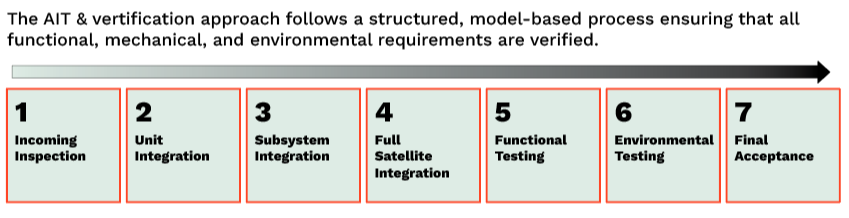
After CDR, the work shifts from defining the satellite to physically building it.
Typical steps include:
PCB fabrication and assembly, followed by electrical checkout of each board
Machining of structural parts (panels, brackets, deployable mechanisms), including coatings and finishing
Procurement and incoming inspection of flight components like sensors, radios, reaction wheels, and onboard computers
Harness manufacturing, where cabling is cut, labeled, and tested to match the system wiring diagrams
None of these happen in isolation. Long-lead components (like radios or star trackers) are often ordered before CDR to protect the schedule, while simpler parts are manufactured afterward.
As hardware becomes available, assembly begins. Subsystems are built up and tested individually before being brought together. For example:
The power system is assembled and tested with representative loads
The onboard computer is powered up and loaded with early flight software
The payload is integrated and functionally verified in a controlled setup
Integration happens step by step, not all at once. The satellite is assembled in stages, with functional tests after each major addition. When the harness is installed, continuity and signal checks follow. When avionics are integrated, system-level power-on tests are run. Each step is meant to confirm that nothing broke during the previous one.
Software integration also ramps up during this phase. Flight software is updated iteratively as real hardware becomes available, moving from simulations to hardware-in-the-loop testing.
Testing is continuous throughout MAIT:
Unit-level tests verify individual components work as expected
Subsystem tests confirm integrated functionality (e.g., ADCS sensors and actuators working together)
End-to-end functional tests simulate real mission operations as closely as possible before environmental testing
At this point, it’s notmal to expect regular integration milestones, test reports, and occasional anomalies. Something not working on the first try is normal. What matters is how quickly the team can isolate the issue, fix it, and move forward without creating knock-on delays.
This phase is also where schedule pressure tends to build. Delays in a single component can block integration, and integration delays can compress the time available for testing. Experienced manufacturers manage this by sequencing work carefully and keeping parallel paths wherever possible.
By the end of MAIT, the satellite is fully assembled, electrically verified, and functionally tested. It hasn’t yet proven it can survive launch or operate in space, but it’s ready to be put through exactly those conditions in the next phase.
Phase 5: Environmental Testing
After integration, the satellite enters one of the most demanding phases of the entire program. Environmental testing is non-negotiable. The journey to orbit and the conditions of low Earth orbit subject hardware to loads and temperature extremes that would destroy poorly qualified electronics. And once it's up there, you can't send a technician.
The standard test sequence covers, at minimum, three main areas:
Vibration testing: simulates the mechanical loads of the launch environment
Thermal vacuum (TVAC): cycles the satellite through the temperature extremes it'll experience on orbit, in vacuum
EMI testing: verifies that subsystems don't interfere with each other or with ground systems
Finding a ground-to-space interface problem on the test floor is infinitely preferable to finding it on orbit. When something fails a test, that's not a disaster. It's the process working exactly as intended. Experienced teams treat test anomalies as data, not emergencies.
Phase 6: Launch Campaign
Once the satellite leaves the factory, the focus shifts to getting it safely into orbit.
The spacecraft is shipped to the launch site, where it goes through final checks before being integrated with the launch vehicle. This typically includes fit checks with the deployer, battery charging, propellant loading (if applicable), and a last round of functional testing to confirm nothing was affected during transport.
For most smallsats, this happens as part of a rideshare mission. Multiple satellites share a single rocket, which keeps costs manageable but introduces constraints around schedule and orbit selection. Launch providers like SpaceX, Isar Aerospace, and others often book out well in advance, so securing a slot early is critical to maintaining your timeline.
The campaign itself can last several weeks, with defined milestones leading up to launch day. Once integrated, access to the satellite becomes limited, and any late changes are effectively off the table.
After launch, deployment is handled by the launch provider. From your perspective, this is the handoff point from a ground-tested system to a spacecraft operating independently in orbit.
Phase 7: In-Orbit Commissioning and Operations
Deployment marks the start of commissioning, where the satellite proves it can operate in the real environment of space.
The first priority is stabilization. The satellite de-tumbles, establishes a safe attitude, and begins generating power. Initial contact is then made with the ground segment, confirming that command and telemetry links are working as expected.
From there, systems are brought online in a controlled sequence. Subsystems are checked one by one, followed by payload activation and calibration. Functional tests performed on the ground are repeated in orbit, this time under actual thermal, radiation, and vacuum conditions.
Commissioning can take anywhere from a few weeks to a few months. Anomalies are expected. This is where edge cases surface. The goal is to resolve them methodically and transition the satellite into stable, routine operations.
Once complete, the mission moves into nominal operations. The satellite begins delivering its intended data or service, with ongoing monitoring, occasional software updates, and performance optimization over its lifetime.
At end of life, the satellite is decommissioned according to its disposal plan. For LEO missions, this typically means controlled deorbiting or passively decaying in compliance with space debris mitigation guidelines.
By this point, the satellite has done its job: designed, built, launched, and proven in the environment it was meant for.
Adaptable vs. Off-the-Shelf: A Decision Framework
This is the question most buyers wrestle with longest and it's worth wrestling with. The answer has real consequences for cost, timeline, and mission outcome.
What Off-the-Shelf Actually Means
When it comes to smallsats, off-the-shelf doesn't mean pulling something from a warehouse shelf. It means buying a satellite bus from a manufacturer's existing product line. It is a platform with defined specifications that you work within rather than define yourself.
The appeal is real: faster time to quote, more predictable cost, hardware that's already been through qualification. The trade-off is equally real: your payload has to fit what the platform allows. If it fits without necessary modifications, off-the-shelf deserves serious consideration. If it doesn't quite fit, you start making compromises, and those compromises can accumulate.
But working with Reflex, a provider that specializes in adaptable satellites, can provide a lot of the benefits of off-the-shelf while still allowing for customization. Utilizing pre-qualified space components with in-house designed systems allows for the predictability that makes off-the-shelf so appealing.
Four Questions That Drive the Decision
1. Does your payload fit an existing platform's envelope? Mass, volume, power draw, pointing requirement, and data interface. If your payload maps cleanly onto a standard platform spec, off-the-shelf is worth pursuing seriously. If any one of those parameters strains what standard platforms offer, you're already in adaptable territory.
2. Is your timeline driven by a fixed window or pre-booked launch date? Hard deadlines can appear to favor off-the-shelf. But this advantage is narrower than it used to be. Experienced manufacturers can deliver adaptable satellites in 12-18 months. It’s worth noting too: your timeline also affects which manufacturer makes sense. Not every manufacturer can hit the same pace and that choice matters as much as the platform choice.
3. Do you need performance margins a standard platform can't provide? High-resolution imaging, radar payloads, high-throughput downlinks, demanding attitude control, these almost always push past what standard platforms comfortably support.
4. Are you planning a constellation? Multi-satellite programs have different economics. A platform designed for your specific payload from the start can be manufactured repeatedly with far less per-unit engineering overhead. A catalog platform doesn't scale as cleanly.
When an Adaptable Satellite Is the Right Choice
Your payload is oversized, power-hungry, or places unusual mechanical demands on the bus
Your mission has dual-use requirements with performance and security constraints that standard commercial platforms weren't designed to meet
You're building a constellation and need a platform optimized for repeatable, high-volume production from day one
When Off-the-Shelf Might Serve You Better
Your payload maps cleanly to an existing platform's specifications
You're running a technology demonstration with a standard instrument and want to minimize program complexity
Budget is the dominant constraint, and you have flexibility on performance margins
The Hybrid Model: Adaptable Buses
Many of the most effective programs in this space don't go to either extreme. An adaptable bus platform with proven architecture, standardized interfaces, and configured around your specific mission, gives you the schedule benefit of heritage design and the performance benefit of mission-specific adaptation. It's the gridlocks path that makes short-term satellite delivery credible for genuinely demanding payloads. Reflex's Praetora platform is built around exactly this principle.
Payload-Agnostic Platforms and What They Mean for Mission Flexibility
A payload-agnostic platform is one designed without assuming what payload it will carry. Mechanical interfaces, power distribution, data bus architecture, and thermal accommodation are all standardized and adaptable, meaning the platform can host a wide range of instruments without fundamental redesign.
What This Actually Means in Practice
Here's the nuance worth understanding: even on a payload-agnostic platform, the bus development is still influenced by the payload. What changes is the nature of that relationship. Rather than the payload locking in a bespoke bus design from the start, the payload requirements inform how a proven platform gets configured. The payload can also be developed in parallel with the bus, each workstream progressing independently until integration.
That parallel development is where the real value lies. Traditional sequential development, where the spacecraft waits on payload definition and the payload waits on spacecraft accommodation, is where programs go long. Breaking that dependency compresses timelines and isolates risk. If the payload schedule slips, which happens more than anyone likes to admit, the spacecraft program doesn't slip with it.
The Practical Benefits for Buyers
For first-time satellite buyers, platform agnosticism offers something particularly useful: room to learn. Early-stage programs often discover partway through that requirements have shifted, a payload has grown, or a better instrument has become available. A platform designed for adaptation absorbs those changes without sending the whole program back to square one.
For constellation operators, the benefit compounds across generations. When you're ready to upgrade instruments for a second-generation fleet, an adaptable bus doesn't require a completely new spacecraft program, just a new payload integration and re-qualification. The investment in the first generation pays forward.
And for programs carrying multiple instruments, the architecture opens up multi-payload configurations on a single bus. Flying two sensors on one satellite instead of two is a significant cost and operational efficiency.
What to Ask About Platform Agnosticism
When you're evaluating a manufacturer's platform, ask the practical questions:
What are the standard payload interfaces, like mechanical, power, data?
What's the maximum payload mass, volume, and power the bus supports?
Has this platform flown with different payload classes?
For context, a well-designed adaptable platform in the upper smallsat class can accommodate payloads up to 250 kg. That’s enough for demanding optical instruments, radar payloads, and complex multi-sensor packages.
Is Your Mission Ready for a Custom Satellite?
The biggest obstacle for most organizations isn't budget or technical complexity. It's uncertainty about whether they're actually ready to start. Here's how to think through it honestly.
Your Payload Doesn't Fit Standard Platforms
This is the clearest signal. If your instrument is too large, too power-hungry, too mechanically complex, or too interface-specific for existing satellite products, the decision is essentially made for you. An adaptable satellite isn't just the better option, it's the only one that actually works.
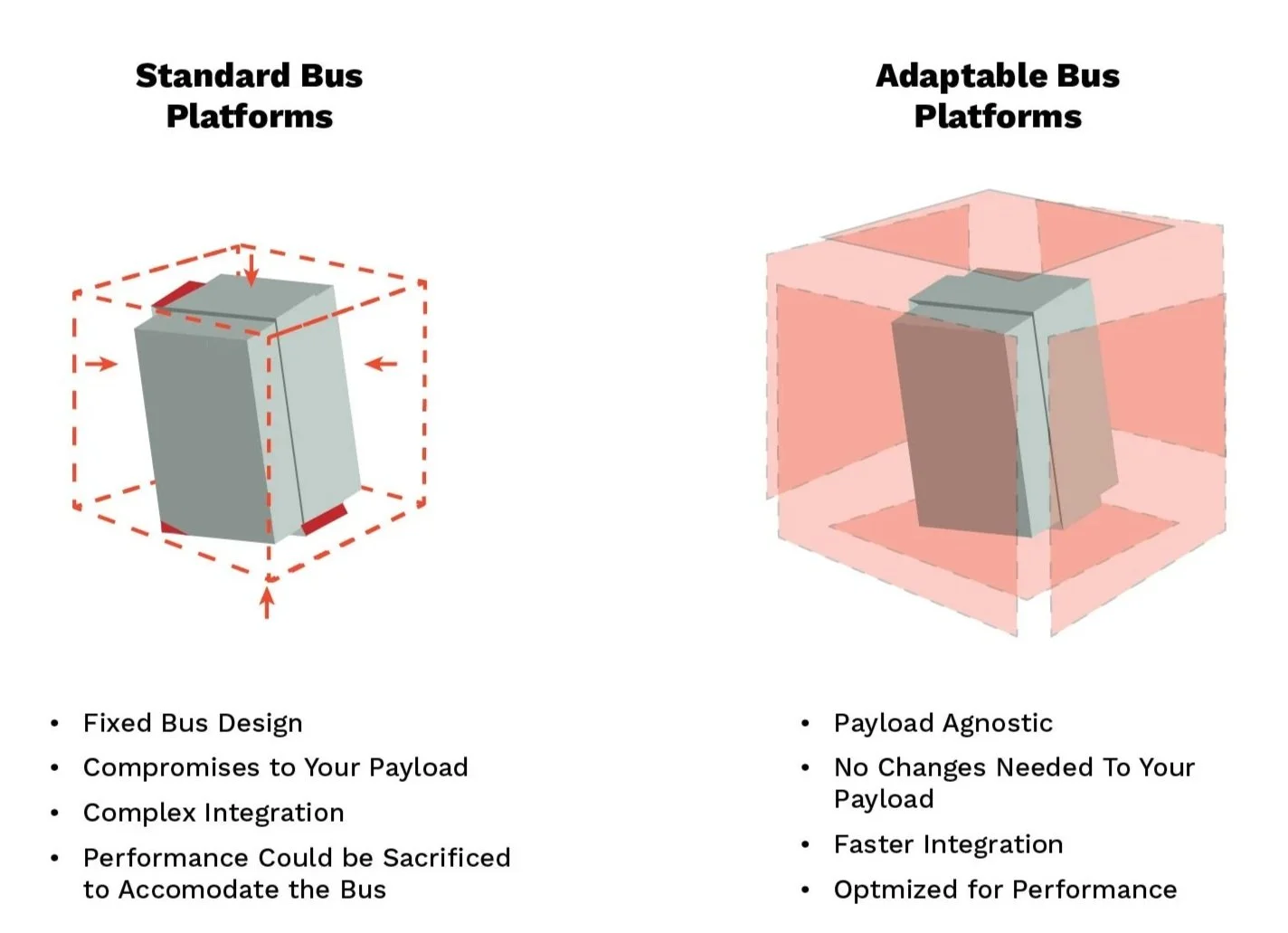
Dual-use payloads often fall into this category. Missions that need to serve both commercial and defense or institutional purposes carry specific interface requirements, security constraints, and performance mandates that standard commercial platforms simply weren't designed to accommodate.
Your Timeline Is Tighter Than Traditional Development Allows
Here's a misconception that still circulates: custom satellite development takes years and off-the-shelf is the only fast option. That's outdated thinking. For programs with genuine urgency, an adaptable satellite can actually be the faster route because you're not spending months engineering workarounds for a platform that doesn't fit.
Your timeline also affects which manufacturer makes sense. Not all manufacturers operate at the same pace. If speed matters, look for a manufacturer with genuine heritage at the delivery tempo you need, not just one that promises it.
You're Building for Scale
Single-satellite programs and constellation programs require different thinking, and the right manufacturing approach for a constellation is almost always adaptable from the start. A bus designed for your specific payload and orbit profile, with your thermal and power architecture built in, can be produced repeatedly with dramatically less per-unit engineering overhead than a standard platform. The first unit in a constellation pays the design cost. Every subsequent unit benefits from it.
You Don't Know Where to Start, and That's Fine
This is the most common situation and it's entirely okay. You don't need a fully formed requirements document to have a first conversation with a manufacturer. You need a clear sense of what you want your satellite to do, a rough view of the application, and an honest assessment of your constraints around budget, timeline, and risk tolerance.
Good manufacturers help you get from that starting point to a proper requirements definition. They ask the right questions, surface the assumptions you haven't examined yet, and tell you plainly if what you're describing doesn't need a custom satellite at all. That last part matters more than you might think. A manufacturer willing to tell you when you don't need their product is one worth trusting when others tell you that you do.
The first conversation isn't a commitment. It isn't a tender process or a requirements review. It's just a discussion about what your mission needs to accomplish and whether there's a credible path to making it happen.
You don't need all the answers before starting that conversation. You just need the right question: what does success look like in orbit?
